Income, Spending and Saving: An Easy Guide for Kids Aged 4 to 10
There are three ideas every child can learn before age 10: income, spending and saving. They're the foundation of almost everything that comes after. The useful question for a parent isn't just what they are, but how to teach them, what they're for and what changes at home once they're understood.
How to do it: one idea per week, with a visible goal
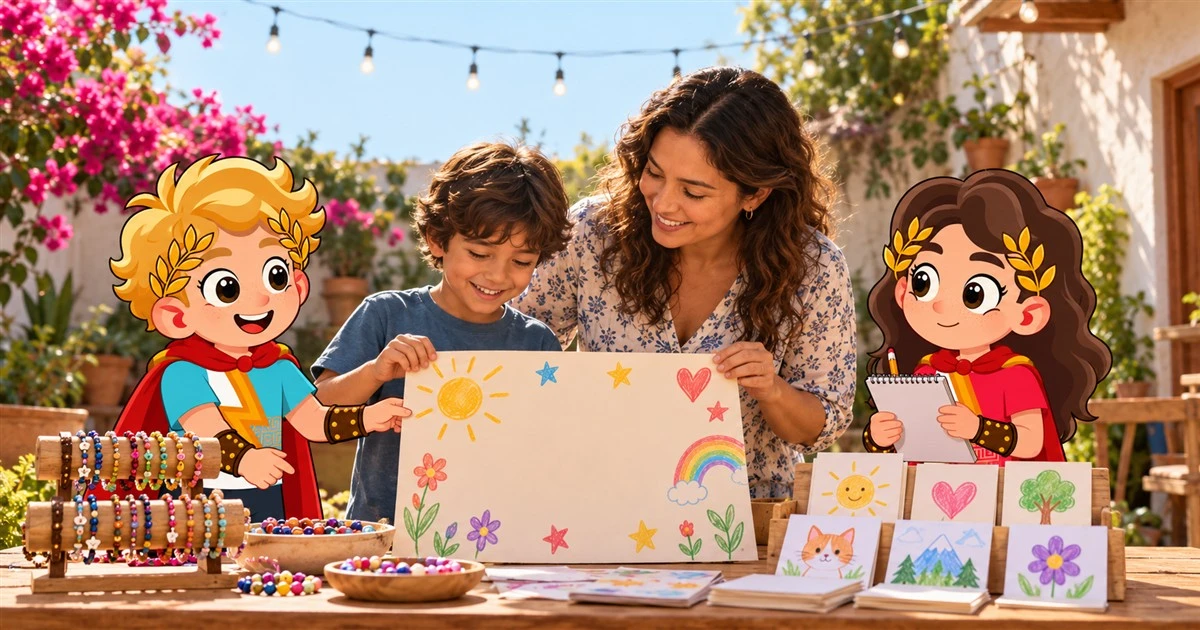
- Income (what comes in): ask "what can you do this week to receive something in return?" Selling a drawing or doing a job.
- Spending (what goes out): before buying, ask whether it's something to need, to want or to give. Put three objects on the table to see it.
- Saving (what we keep): name a goal on a sheet and draw a bar. Each week they save a part, color it. Let the child choose the name and the drawing.
Teach one idea per week, not all three in one long talk.
What it's for
For your child: income shows that money comes from effort; spending, that each purchase is a choice; saving, that waiting has a reward. They feel more capable, and the bar gives them something to see: Teresa Amabile and Steven Kramer (The Progress Principle) found at work that noticing small steps forward is among what motivates people most, and it's reasonable to expect the same in a child. For you: fewer fights over "I want," because you now share a language: "is it a need or a want?"
What the research says
Beth Kobliner (Make Your Kid a Money Genius) arranges these ideas by stages, and Berti and Bombi (The Child's Construction of Economics) show that children build them gradually. In Walter Mischel's experiments (The Marshmallow Test), waiting got easier when the child had a strategy and a clear picture of what was coming; the goal with a bar does exactly that.
What you'll see over time
- First weeks: they color the bar eagerly and repeat "income," "spending," "saving."
- Three to six months: they complete a small goal and start choosing the next one.
- Long term: the Dunedin study (Moffitt and colleagues, 2011) followed a generation from childhood and found that early self-control predicts health, economic situation and conduct in adulthood; saving for a goal is an everyday way to practice it.
Signs it's working
They say "I'm saving it" instead of "I don't have it"; they ask how much is left for the goal; and they tell need from want without being asked. If they lose interest, make it shorter: a goal reached in two weeks is worth more than one that takes three months.
Recognize income, spending and saving as three different ideas.
Sort objects by whether they are needed, wanted or kept.
Save part of what they receive and check progress.
"What comes in, what goes out, and what we keep."
Most common error
Try it here too
To practice at home: the workbook Be a Real Hero has financial literacy activities to repeat these ideas. https://a.co/d/0g6BVfUK