When Your Child Thinks Money Comes From the ATM
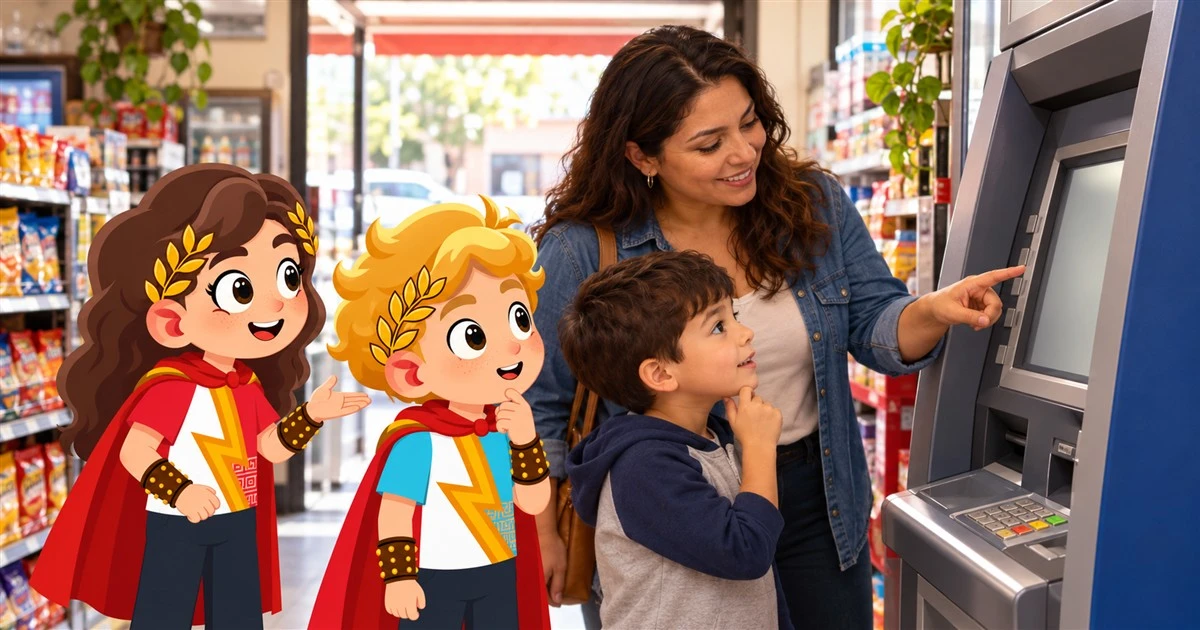
A child who sees a parent pay by card or take money from the ATM may think money comes out of the wall. Berti and Bombi, in The Child's Construction of Economics, observed that young children often believe the bank or the ATM simply "gives" money, and only later understand where it comes from. It's not a flaw in the child: it's what they see.
How to do it: three gestures
- Say where it comes from: "Money comes from work. Mom works, so she gets paid."
- Make the cost visible: "This costs as much as Mom earned this week." Vicki Robin and Joe Dominguez (Your Money or Your Life) propose measuring purchases in work time: "This is an afternoon of work."
- Give them a small job and something in return, so they live the whole path: doing, receiving, deciding.
And when they already get it, show them the payment on your phone: "This was paid with Mom's work this week."
What it's for
For your child: money stops being magic and gets an origin and a cost; they understand why the answer is sometimes "no." They feel part of the home and not shut out of a mystery. For you: you step out of defending ("because I said so") and can explain; it's a relief to say where money comes from without dramatizing.
What the research says
Albert Bandura showed that children learn from what adults do and say: if you pay in silence, money will keep seeming like magic. Drazen Prelec and George Loewenstein described the "pain of paying": with a card or ATM, the cost is felt less, for an adult too.
What you'll see over time
- First weeks: they repeat "money comes from work" and ask "how much is it?"
- One to three months: they link asking with having to "earn," and accept waiting better.
- Long term: a solid base for understanding income, spending and saving.
Signs it's working
They ask where money comes from in their own words; they use "work" when talking about buying; and they stop saying "the ATM gives money." You don't need a lesson: just say it while you pay.
Understand that money comes from doing something.
Ask the cost before asking for something.
Explain where money comes from in their own words.
"Money comes from doing something, and everything has a cost."
Most common error