Grandma's Stories: When Money Was an Adult Topic
Many Latino families grew up with one phrase: "money is a grown-up topic." It was rarely discussed, hidden, or mentioned only when there were problems. That story comes from somewhere, and it's worth looking at. Morgan Housel (The Psychology of Money) writes that nobody's crazy with money: everyone decides from what they lived, and those experiences shape what we do more than any data.
How to do it: three steps, one conversation
- Name what you learned from your family: was there pride in hard work, fear of not having enough, shame about asking?
- Decide what you want to keep and what you don't.
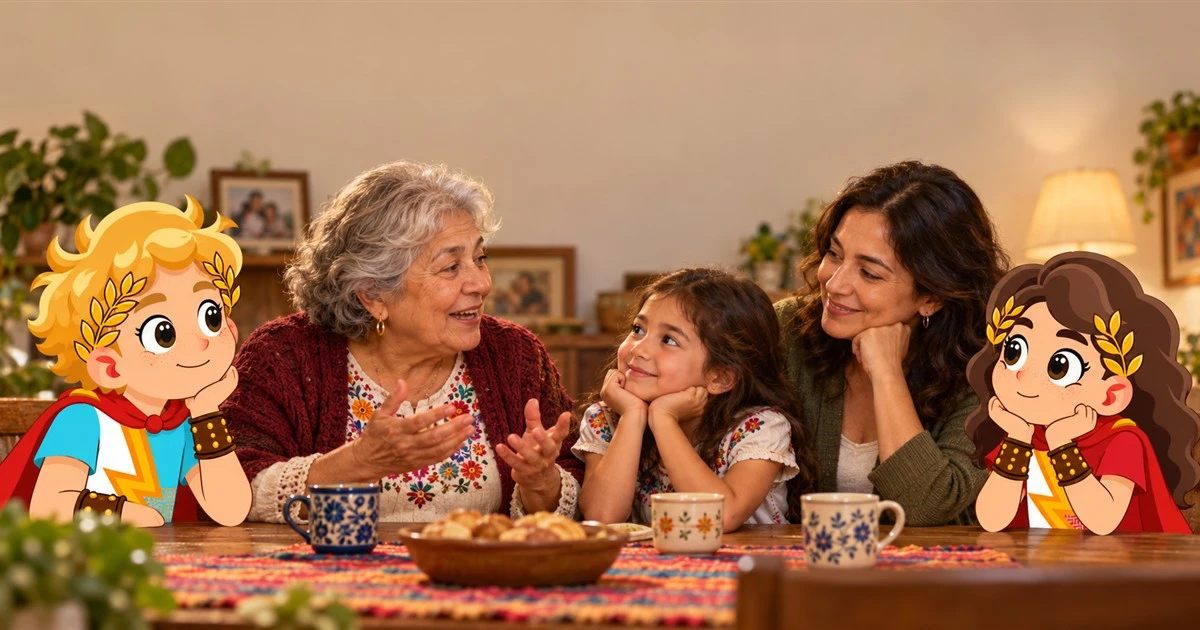
- Tell your child a real, short story from your childhood: "When I was a girl, my mom counted every coin. I want you to understand money as something you choose, not something that scares you."
A question to your family helps: "What do you remember about how money was talked about at home?" Listening to the older ones shows where your ideas come from.
What it's for
For your child: they stop perceiving money as a dangerous secret and gain words to ask questions; they feel part of the family's story. For you: putting words to the story usually eases shame and lets you decide what you inherit and what you don't; it's an act of love toward your elders and yourself.
What the research says
Albert Bandura showed that children learn from what they see and hear at home, even what nobody says. Ron Lieber (The Opposite of Spoiled) argues for talking about money honestly and at the child's level, and Gudmunson and Danes (2011) describe that parents' intent and the quality of the relationship weigh more than the amount of information.
What you'll see over time
- First weeks: your child asks more about "when you were little" and about money.
- One to three months: they tell what they understand in your same words.
- Long term: a less tense relationship with money for them, and an open conversation across generations.
Signs it's working
They ask you questions; they repeat what you told them in their own words; and the topic stops creating awkward silence. Talking about money isn't only for adults when it's done with love and truth.
Understand that ideas about money are inherited and can be chosen.
Tell a story and draw a lesson from it.
Talk about money naturally at home.
"Money can be talked about at home, with love and truth."
Most common error