How to Tell If Your Child Learned Something About Money, Without Tests
A test measures what a child remembers at one moment. What matters is what they use in daily life, and those signs can be observed. Teresa Amabile and Steven Kramer, in The Progress Principle, found that noticing small steps forward is among what motivates people most, and that holds for the adult who observes too.
How to do it
There are four signs. They explain in their own words: "Saving is waiting for something I want more." They ask before asking for something: "How much does it cost?" They propose an alternative: "Better we buy this and save the other." They recognize a need: they tell what is needed from what is wanted.
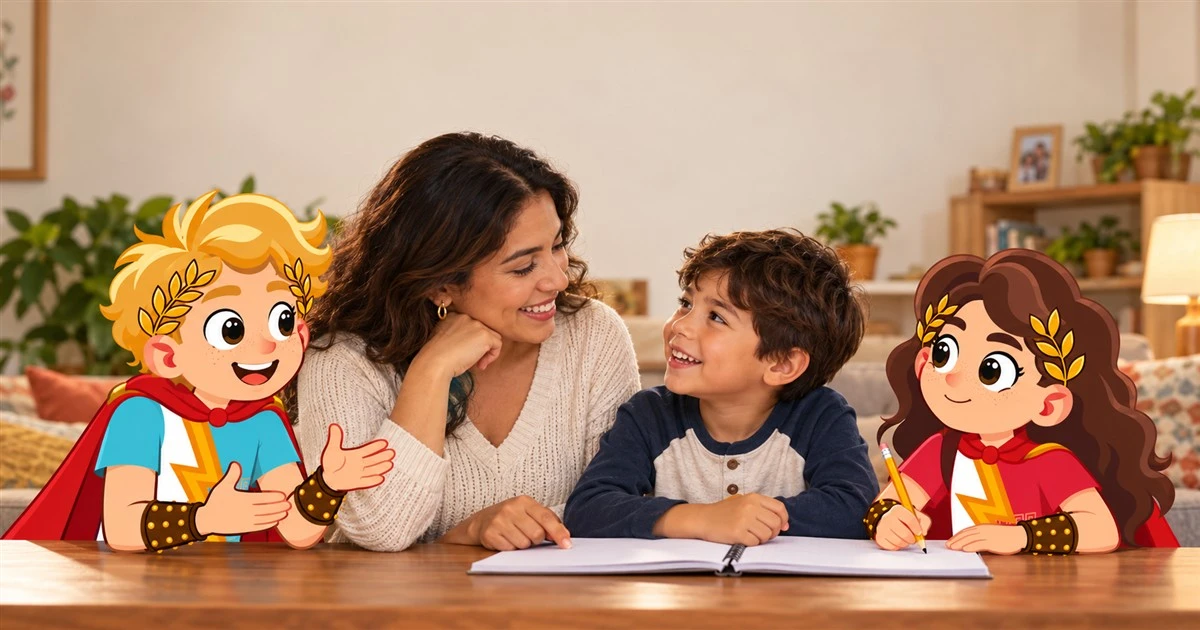
To record them, write down one sign a week in a notebook, as an observation and not a grade. If a sign shows up more than once, it's already learning. You can use a three-level scale: "starting," "on the way" or "achieves." That scale shows what to practice next week.
What it's for
For your child, the conversation about money isn't lived as a grade, because the adult keeps the record and what's evaluated is the reasoning. For you, progress shows up in a notebook with dates, and that replaces the question "do they know it yet?" with "what did they use this week?"
What the research says
Carol Dweck, in Mindset, recommends measuring progress against the child's own starting point and not against others. Review your notes from the first month and compare them with the third.
Brown, Roediger and McDaniel, in Make It Stick, show that recalling with little at stake fixes learning. A casual question in the car, "remember what we did with the money at the store?", is a memory rehearsal without a test. You don't reward only the right answer: the reasoning matters, even when the decision isn't the one you expected.
What you'll see over time
In the first weeks the signs appear rarely; write them down anyway. Between one and six months the signs repeat and you can see a trend. In the long run the child recognizes their own progress and asks about it.
Signs it's working
It's working when a sign repeats, when the child asks you to look at their progress and when their reasoning changes even if the decision is different from what you expected.
Understand that reasoning is worth more than the right answer.
Record one observation a week.
Observe concrete signs of understanding in everyday life.
"Progress is measured against the child's own starting point, not against others."
Most common error