Paying by Card and the Cost You Can't See: An Easy Guide for Parents
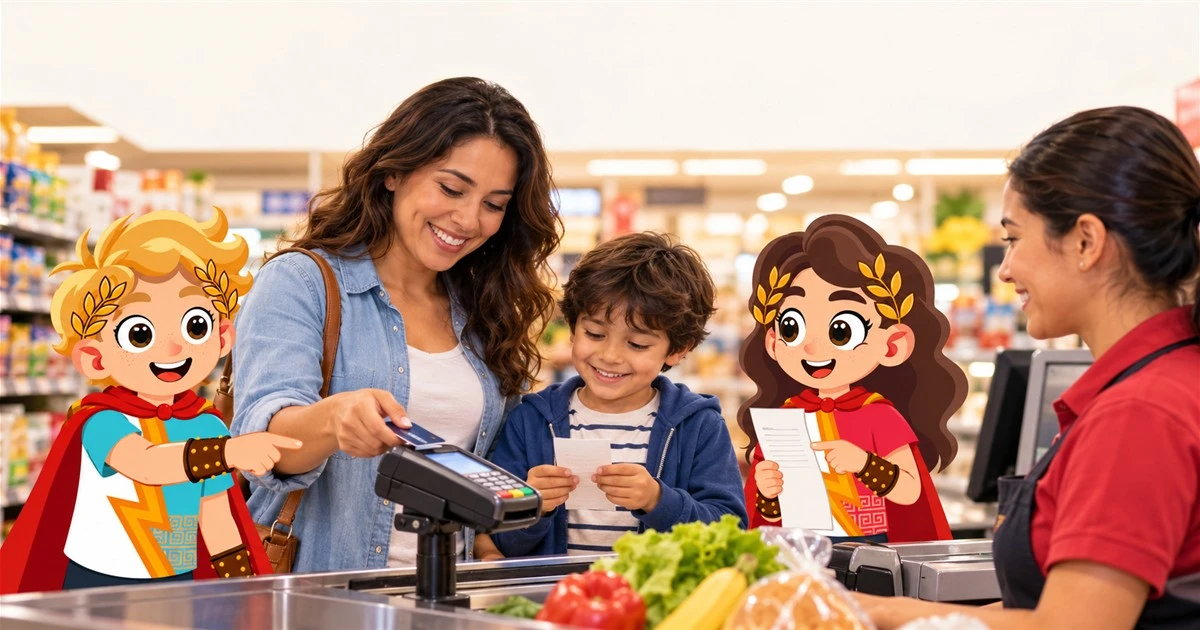
When you pay by card, the money never visibly changes hands: your child sees you swipe a card and walk away with something, and concludes that things cost nothing. It's not a flaw in them, it's what they see. The good news is that three gestures of under a minute fix it.
How to do it: three gestures with every purchase
- Say the total out loud: "Today's groceries cost 87 dollars."
- Show the receipt and point to one line: "The bread cost 3. And this, which we didn't need, cost 6."
- Connect the cost to something they understand: "That money isn't available for something else. With 6 dollars we could have gone to the park with an ice cream."
If your child can count, keep the week's receipts in a folder and ask them to add up three. To go further, Vicki Robin and Joe Dominguez (Your Money or Your Life) propose measuring a purchase in work time: "That's what we earn in one afternoon of work." For a child, the work behind the money is the missing piece.
What it's for
For your child: they understand that every payment is a decision and that money runs out, so the "no" stops looking like a whim. They feel included instead of shut out of a "grown-up" topic, which lowers frustration when they can't buy something.
For you: you stop defending with "because I said so" and start explaining with a number. It's reasonable to expect less tension at the store and more coherence with yourself: what you do and what you say match.
What the research says
Drazen Prelec and George Loewenstein described the "pain of paying": handing over cash hurts, and that pain fades with a card. Prelec and Simester (2001) found that people were willing to pay more when they could use a card than when they had to pay cash. If it happens to adults, a child, who doesn't even see the outflow, feels it more. Albert Bandura showed that children copy what they see: if you name the cost, they learn to look at it.
What you'll see over time
- First weeks: they start repeating your phrases and asking "how much is it?" at the store.
- Three to six months: they compare two things before asking and accept "not today" more easily once they understand the number.
- Long term: research on financial socialization (Gudmunson and Danes, 2011) associates early conversation at home with more conscious spending habits in adulthood; it's an association, and naming the cost is one of the simplest ways to practice it.
Signs it's working
They ask the price before asking for something; they use "need" and "want" on their own; and they stop saying "it was paid by card" as if it were free. If nothing changes after a month, don't add things: cut the practice down to one gesture, naming the total, and do it every time.
Understand that paying by card is also spending money.
Ask whether something is needed before paying.
Recognize that every purchase has a cost, even when it isn't visible.
"Every purchase costs something, even when we can't see it."
Most common error