What a Ploutus Lab Printable Sheet Does and How to Use It
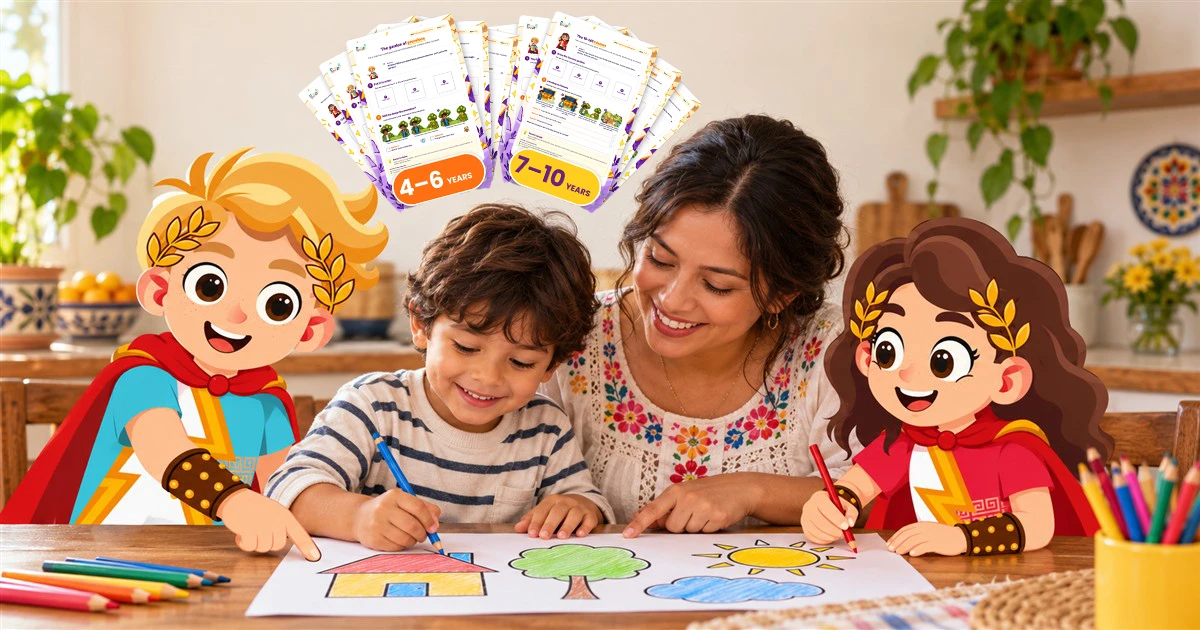
When each class ends, your child can do a printable sheet: a short paper practice that repeats the class idea with objects and simple instructions. It's the moment they go from watching to doing.
How to do it
The sheet practices one sub-concept from the class: sorting, matching, ordering, choosing or completing. The child does the activity with a pencil and you accompany. There are different sheets by age range, so a 5-year-old's isn't a 9-year-old's.
At home, print the sheet for their age, read the instruction together and let them do it with a pencil. At the end, ask why they chose that answer.
Doing something with your hands and explaining it takes more than watching, and that demand fixes the idea. Brown, Roediger and McDaniel, in Make It Stick, describe that learning that takes a little effort is the learning that lasts. The sheet also stays: you can review it in a month and see how far they've come.
If the sheet seems too easy or too hard, check the birth date on the profile, because the range sets the material. Mihaly Csikszentmihalyi, in Flow, explains that attention holds when the challenge matches the skill. If a sheet goes undone one day, do it another day.
What it's for
For your child, the sheet is the part of the class they can touch and correct. For you, the sheet is a record of what they understood, which you can review without giving them a test.
What you'll see over time
In the first weeks the sheet may seem like one more task. Between one and six months they do it with less help and explain why they chose. In the long run the saved sheets show a change you can see on paper.
Signs it's working
It's working when they explain their answer without being asked, when they ask for the sheet and when you can compare two sheets from different months.
Understand that doing something with their hands fixes the idea.
Practice the class idea on paper.
Sort, match or order according to an instruction.
"The class teaches the idea, the sheet practices it."
Most common error